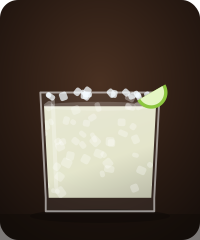
Caipirinha
Cachaça, muddled lime and sugar over crushed ice. Brazil's national cocktail, rough-edged and refreshing.
- MethodBuilt
- GlassRocks (old fashioned) glass
- IceCrushed
- Strengthabout 24.0% ABV
- BaseRum
- Tastesour, refreshing, strong
Recipe
| 4 wedges (half a lime) | Lime (cut into wedges) |
| 2 barspoons | Caster (superfine) sugar |
| 60 ml 2 oz | Cachaça |
Garnish. The muddled lime pieces stay in the glass; a fresh wedge on the rim is optional.
Method
- Cut half a lime into four wedges and trim away the white pith from the centre.
- Put the lime and sugar in a rocks glass and muddle firmly to press out the juice and dissolve the sugar.
- Fill the glass with crushed ice and pour in the cachaça.
- Stir well, lifting the lime from the bottom, and top with a little more ice.
About the Caipirinha
The Caipirinha is Brazil's national drink: cachaça, a spirit distilled from fresh sugarcane juice, poured over lime wedges muddled with sugar. Muddling the whole wedge releases oil from the peel as well as juice, so it tastes more aromatic and slightly more bitter than a shaken sour. It is grassy, tart and strong.
History
Documented
The drink comes from Brazil, and is generally placed in the interior of São Paulo state, a sugarcane region around Piracicaba. Cachaça has been distilled in Brazil since the colonial era, and lime and sugar were obvious partners. Brazilian law defines cachaça as a spirit made only in Brazil, and the Caipirinha is widely treated as the national cocktail. The name is a diminutive of caipira, a word for a country person from the interior.
Legend and lore
A common story says the drink began as a remedy during the 1918 influenza pandemic, made from lime, garlic, honey and cachaça, and lost the garlic and honey over time. Other Brazilian historians place its origin among São Paulo landowners in the 19th century. Neither version is supported by documents from the time.
Disputed or unclear: The origin of the Caipirinha is undocumented; the timeline year follows the popular 1918 story and should be read as approximate.
Variations
- Caipiroska. Vodka instead of cachaça; cleaner and more neutral.
- Caipifruta. With fresh fruit such as passion fruit or strawberry muddled in alongside the lime.
- Mojito. Cuba's muddled rum drink, with mint and a splash of soda.
- Ti' Punch. The French Caribbean equivalent with rhum agricole, served without ice.
Bartender's notes
- Remove the pith from the middle of the lime; it is the bitterest part.
- Use granulated or caster sugar rather than syrup. The grains help scrape the oil from the peel as you muddle.